

Spain has long relied on foreign workers to support its economic sectors, particularly in industries where local labour supply cannot fully meet demand. In recent years, demographic changes, economic growth in certain regions, and sector-specific labour gaps have intensified the need for skilled and semi-skilled workers across the country. As a result, Spanish immigration policies increasingly reflect labour market realities.

One important factor influencing immigration decisions is the presence of provincial shortage occupations. These are professions where employers struggle to find sufficient workers within Spain or the wider European labour market. When such shortages occur, immigration authorities may allow employers to recruit workers from outside the European Union more easily.
Understanding provincial shortage occupations and their impact on Spanish residency approvals is therefore essential for migrants, employers, and policymakers. Labour shortages can significantly influence the Spanish residency approval process, particularly for work-based residence permits and employment authorisations. This article examines how labour market shortages are identified, how they influence immigration policies, and how they affect residency approvals for foreign workers seeking opportunities in Spain.
Understanding Labour Shortages in Spain’s Provinces

What Are Provincial Shortage Occupations?
Provincial shortage occupations refer to jobs that cannot easily be filled by workers already available within a specific region or province of Spain. Labour shortages often arise when the demand for workers exceeds the local labour supply due to demographic, economic, or sectoral factors.
For example, industries such as agriculture, construction, hospitality, healthcare, and transportation frequently experience workforce shortages in various Spanish provinces. Seasonal work patterns and regional economic structures often contribute to these shortages. The Spanish government monitors labour demand through employment services and labour market data to identify sectors facing significant recruitment difficulties. When such shortages are confirmed, authorities may introduce measures to facilitate the recruitment of foreign workers.
The Role of Spain’s Shortage Occupation Lists
Spain periodically publishes lists of occupations considered difficult to fill through local labour markets. These lists are compiled by the Public State Employment Service (Servicio Público de Empleo Estatal – SEPE) and are commonly known as the Catalogue of Hard-to-Fill Occupations.
The catalogue identifies positions where employers are permitted to recruit foreign workers without first proving that no suitable candidate is available within Spain or the European Union. This mechanism simplifies the Spain work permit approval process for certain professions.
Typical examples of shortage occupations include:
- maritime and fishing industry roles
- specialised technical positions
- some transportation and logistics jobs
- seasonal agricultural work
- construction and maintenance roles in certain provinces
By recognising these shortages, the Spanish government aims to maintain economic productivity while ensuring labour market stability.
How Labour Shortages Influence Spanish Residency Approvals
Faster Processing of Work Authorisations
One of the most significant impacts of labour shortages is the possibility of faster work permit approvals. When an occupation appears on the shortage list, employers do not always need to conduct the usual labour market test demonstrating that no local worker can fill the role.

This simplifies the administrative process and increases the likelihood that a foreign worker will obtain both a work permit and a residence authorisation in Spain.
Greater Opportunities for Non-EU Workers
Provincial labour shortages often create new immigration opportunities for workers from outside the European Union. Employers facing recruitment challenges may actively seek foreign labour to maintain operations and productivity. As a result, applicants with skills aligned with occupations in demand in Spain may find it easier to obtain employment contracts, which are essential for most work-based residence permits.
Regional Differences in Residency Approvals
Spain’s labour market varies significantly from one province to another. While some regions have relatively high unemployment, others face shortages in specific sectors.
For instance:
- Coastal provinces may require more hospitality and tourism workers.
- Agricultural regions may depend heavily on seasonal labour.
- Industrial provinces may experience demand for technical or mechanical skills.
These regional differences mean that Spanish residency approval outcomes may vary depending on the applicant’s profession and the location of employment.
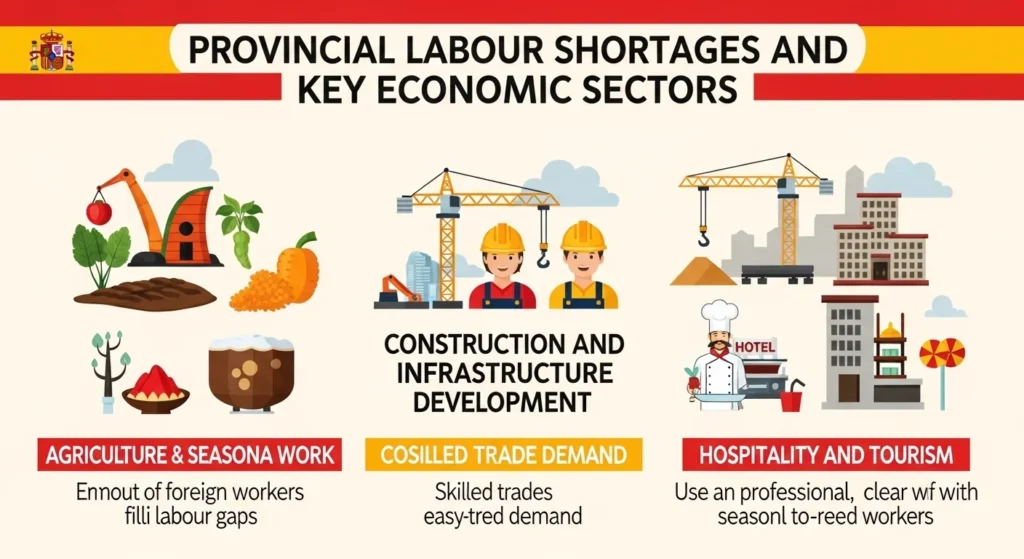
Provincial Labour Shortages and Key Economic Sectors
Agriculture and Seasonal Work
Agriculture is one of the sectors most affected by labour shortages in Spain. Harvest seasons require a large workforce for short periods, and local labour supply is often insufficient. Foreign workers therefore play a crucial role in supporting Spain’s agricultural economy.
Programmes allowing temporary work permits help address these shortages while providing legal employment opportunities for migrants.
Construction and Infrastructure Development
The construction sector has experienced fluctuations in labour availability, particularly during periods of economic recovery and infrastructure expansion. Skilled trades such as masons, painters, electricians, and plumbers are frequently in demand in certain regions.
Labour shortages in construction can influence the Spain immigration labour market needs, encouraging authorities to approve work permits more readily for qualified workers.
Hospitality and Tourism
Tourism remains one of Spain’s largest economic sectors, employing millions of workers each year. Seasonal peaks in visitor numbers create strong demand for hospitality staff, including chefs, hotel workers, and service personnel.
In regions where tourism dominates the economy, employers may rely on foreign labour to maintain service standards during busy periods.
Policy Framework Behind Spain’s Labour Migration System
Spain’s immigration system attempts to balance economic needs with labour market protection. Authorities generally prioritise employment for Spanish and EU citizens, but they also recognise that labour shortages can hinder economic growth.

address this challenge, the government uses several policy tools:
- shortage occupation catalogues
- seasonal worker programmes
- bilateral labour agreements with specific countries
- training-based residence pathways
These mechanisms ensure that immigration policy remains aligned with Spain labour shortage occupations and national economic priorities.
Challenges and Considerations in the Approval Process

Despite labour shortages, obtaining Spanish residency approval through employment is not always straightforward.
Applicants must still meet various requirements, including:
- valid employment contracts
- compliance with labour regulations
- employer financial capacity
- clean criminal records
- appropriate documentation
Additionally, immigration authorities carefully assess each application to prevent exploitation or fraudulent employment practices.
Final Thoughts
Labour shortages play a crucial role in shaping immigration policies across Spain’s regions. By identifying sectors where local labour supply is insufficient, authorities can design immigration pathways that support economic stability while maintaining fair labour market practices.

Understanding Provincial Shortage Occupations and Their Impact on Spanish Residency Approvals provides valuable insight into how labour demand influences immigration decisions. Workers whose skills align with Spain labour shortage occupations may benefit from improved employment opportunities and a smoother Spanish residency approval process. At the same time, regional labour market dynamics continue to shape Spain’s broader immigration strategy.
As Spain faces demographic ageing and evolving economic needs, provincial labour shortages are likely to remain an important factor in determining future Spain work permit approvals and residency pathways for foreign workers.
FAQs
How often are Spain’s shortage occupation lists updated?
Shortage occupation lists are typically reviewed periodically by Spanish employment authorities to reflect changing labour market conditions. Updates depend on regional employment data and employer demand.
Do shortage occupations guarantee residency approval in Spain?
No. While they may simplify the hiring process, applicants must still meet immigration requirements such as valid documentation, legal contracts, and background checks.
Which sectors in Spain commonly rely on foreign workers?
Agriculture, tourism, construction, transportation, and certain technical professions frequently recruit foreign workers due to labour shortages.
Can shortage occupations help migrants apply for long-term residency?
Employment in shortage occupations may help migrants obtain initial residence and work permits. Long-term residency typically requires several years of legal residence in Spain.
Are shortage occupations the same across all Spanish provinces?
No. Labour shortages vary by region depending on economic activity, demographics, and seasonal employment patterns.